

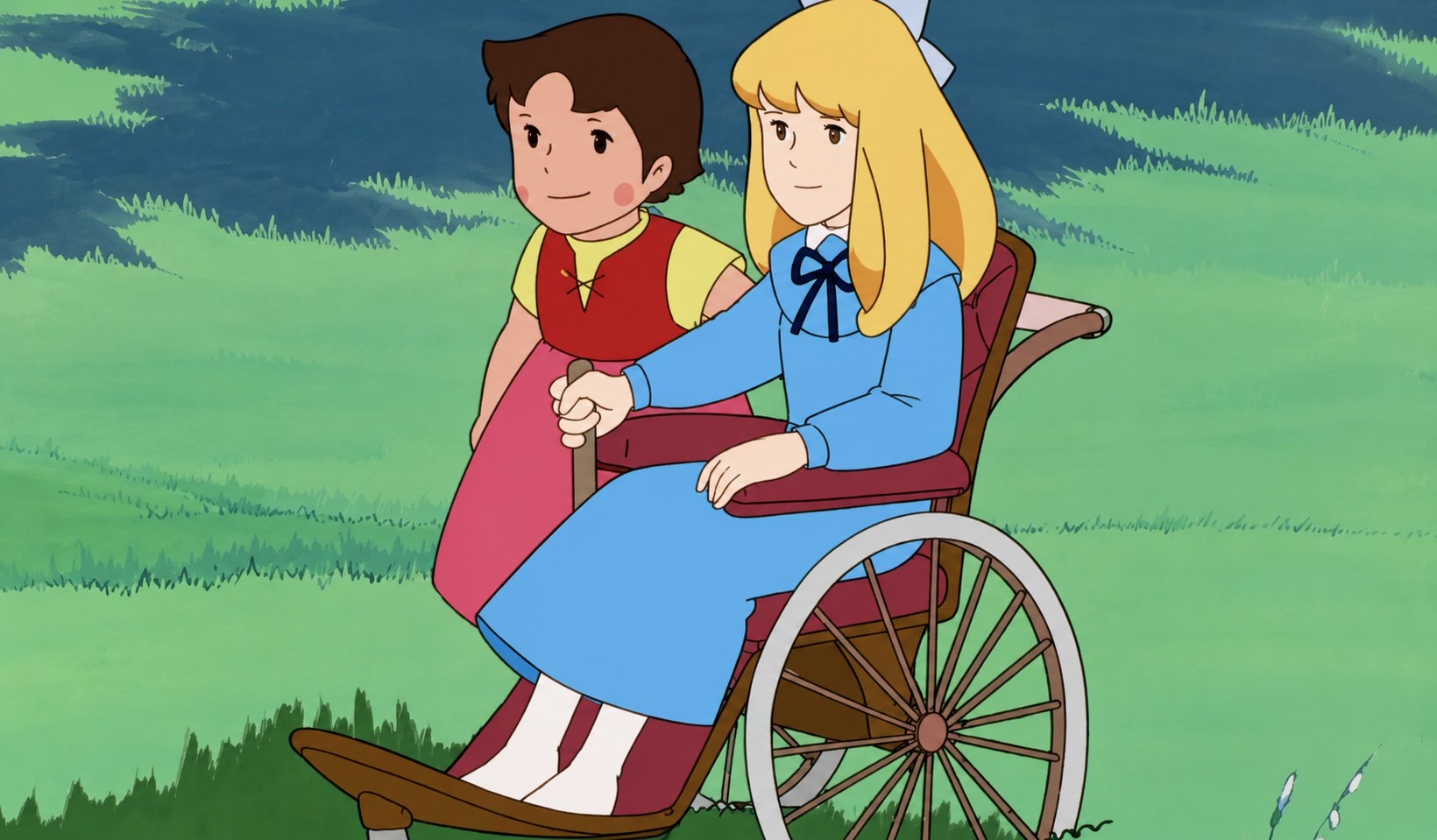

In the cartoon Heidi, we all remember the character of Clara Sesemann. She is the girl in the wheelchair, though nobody ever says what condition she has. Frail and pale, she lives in Frankfurt in an enormous house, with a terrifying governess and a father who is often away on business.
When Heidi arrives, she brings the carefree joy that the house had been missing. Then they move to the Alps, where Clara breathes fresh air, drinks fresh milk, warms herself in the sun and exercises. In the Alps Clara grows stronger, though she is easily discouraged and inconsistent. Heidi becomes exasperated and ends up getting so angry with her that she treats her badly: Clara must try to walk, and she must want to if she is to succeed!
And sure enough: Clara wants to, and she succeeds.
At the end, when Herr Sesemann and her grandmother arrive, Clara walks out to meet them. Her father looks at her, incredulous and moved!
As children of the Seventies and Eighties, we understood perfectly what we were supposed to see in this sequence of non-causal events. The miracle, the reward and the hope. Clara had done it: partly on her own, partly bullied and partly cosseted by Heidi while the little goats waved hello.
I happened to watch this episode with my daughter Margherita when she was about five. Margherita really does need a wheelchair. We know her diagnosis very well, and we also know that the Alpine air would do nothing for her.
Margherita saw that Clara, with whom she had felt a sense of solidarity at the start of the series, had got up and, with the frankness children have, told me plainly: “Clara was pretending, she’s been fooling us. This is a tantrum! If she can walk, why has she spent all this time in a wheelchair complaining?”
In the 1974 Japanese anime, Clara’s condition is presented as real, though no diagnosis is mentioned, and her recovery is built up gradually through glasses of milk and Alpine sunshine.
Margherita had seen something in it that I had not seen as a child, and that everyone who still broadcasts it continues not to see: an almighty tantrum. Someone who makes a meal of it, who does not have a real disability and who gets better whenever she feels like it.
And today I notice that the story plays on that ambiguous, diagnostically non-existent territory where physical limitation becomes mingled with willpower.
Why do the authors make Clara’s recovery depend on her willpower?
Johanna Spyri published the two Heidi books in 1880 and 1881. Almost a century later, in 1974, Isao Takahata turned them into the animated series we know in Japan, with Hayao Miyazaki also working on it. Two vastly distant eras, two different cultures, yet one thing remains intact between the book and its adaptation into anime: Clara’s story reaches its fulfilment when Clara walks.
There is, however, an enormous difference between 1880 and 1974. When Johanna Spyri writes the book, disability still belongs almost entirely to the realm of care and charity. During the nineteenth century, separate institutions had been established in Switzerland for deaf children, blind children, children with intellectual disabilities and, from 1864, children with physical disabilities too. The idea that a disabled person might claim the right to remain in precisely their own physical condition and instead ask society to make a full life possible for them was still a very long way off.
Seen from there, Clara works perfectly. She is a sick child, and the best ending to her story is for her to stop being one. Medicine cannot cure her, but the mountains, milk, exercise, Heidi and a good dose of willpower can. It is a nineteenth-century solution to a problem conceived in nineteenth-century terms.
Almost a century later, when Isao Takahata makes the animated series, something very significant is happening in the world. And naturally it is happening in Japan too.
From the late Sixties, people with physical disabilities, including severe ones, begin openly challenging the idea that their natural destiny is to live shut away at home or in institutions. They ask why someone in a wheelchair cannot take a bus, enter a station, go to the cinema or simply cross a city.
Public protests against inaccessible transport and streets emerge in Japan and, towards the mid-Seventies, groups of disabled people begin producing actual maps of urban accessibility.
Above all, there is a very interesting movement already active since 1957, Aoi Shiba no Kai, the Green Grass Association, founded among people with cerebral palsy. Around 1970 it becomes one of the most radical strands of the Japanese disabled people’s movement.
At its heart is an idea that seems almost obvious to us today but was anything but then: a disabled person is not merely someone to be looked after. They are an individual who speaks for themselves, demands rights and challenges the way non-disabled people have decided their life should be.
The contrast becomes still more striking because the Japan of those years contains opposing ideas at the same time. Between the mid-Sixties and the early Seventies, some local administrations had promoted policies explicitly described as movements to prevent the birth of “unhappy children”, linking disability prevention and prenatal diagnosis. Part of disabled people’s protest developed in direct opposition to that conception.
And in 1970 Japan also passes its first basic law on disabled people. It was still a law firmly tied to prevention, rehabilitation and protection, and thus very far from the contemporary understanding of disability. But it nevertheless marked the issue’s entry into the sphere of the State’s public responsibility.
Something similar was happening in Italy. In 1971, Law 118 establishes that disabled pupils must be able to reach school, enter it without architectural barriers obstructing them, and receive assistance during school hours. The same law says something even more concrete: public buildings must become accessible, and public transport, including underground railways and trams, must also be usable by “non-ambulant invalids”, as they were called at the time.
In 1977, Law 517 would take the principle of integrating disabled pupils into mainstream schools much further.
Something was also stirring internationally. In December 1975, a year after Heidi’s release, the United Nations adopted the Declaration on the Rights of Disabled Persons. The language is still that of the period and retains a strong emphasis on rehabilitation, but dignity, civil and political rights, social integration and access to services clearly appear. In 1976, the UN would then decide to designate 1981 the International Year of Disabled Persons.
This is what makes the 1974 cartoon more interesting than the 1880 novel.
Takahata takes a story written when the best answer anyone could imagine for Clara was to cure her, and brings it almost intact into a world that is beginning to ask the opposite: what would happen if Clara did not get better? Could she still be happy? Does she have the right to be?
It is the shift, still incomplete in the Seventies, from one question to another. First: how do we make Clara as much like everyone else as possible? Then: how do we build a world in which Clara can live like everyone else even if she continues to be Clara?
The animated series emerges precisely on the fault line between these two ideas. But when it has to decide what ending to give the girl in the wheelchair, it still chooses the one from 1881.
Even though it was in those very years that another resolution to the story was beginning to become conceivable. Not changing Clara, but changing Frankfurt. Changing the school, the house, the streets, the means of transport and the attitudes of the people around her. Making sure that wheelchair could take her everywhere.
There is nothing offensive about wanting to walk. If tomorrow medicine made it possible for someone who cannot walk to do so, it would be perfectly understandable to be happy about it.
The cartoon’s failing, in fact, is that it seems to allow Clara no other possible happiness than walking.
She can have Heidi. She can have her father. She can have the mountains. She can laugh, learn, grow stronger, leave the house in which she was shut away and discover the world. But her story remains incomplete. Because in the authors’ intentions she remains incomplete. The happy ending comes only when Clara walks.
And indeed, at the end, her father does not return simply to find his daughter happy. He finds his daughter standing.
A hundred and fifty years after the book and more than fifty years after the cartoon, I wonder what would have happened if Clara had never got up. Clara could have grown up, studied, fallen in love, had friends, travelled, worked, become an interesting woman, married and had children, while continuing not to walk. I can think of dozens of women in wheelchairs who do all this and have done so.
Could she have loved the mountains without the mountains curing her? Could her father have arrived at the end of the story, found her still in her wheelchair and thought: my daughter is happy and I love her so much?
That story was not written. Indeed, the wheelchair has to be destroyed. It is a very interesting object in narrative terms. At first it allows Clara to move around.
For someone who cannot walk, that is precisely what a wheelchair is: mobility, independence and every possibility. But not in Clara’s story; there it means something else: a paradoxical cage to which she would like to return when she is afraid to walk.
Is the fear of walking Clara’s disability? A cage, a yoke that must be destroyed to be free to be happy. Indeed, the author sends it plunging down a ravine and renders it unusable, making it leave the scene tragically (for her).
Consider the semantic distortion: from an instrument of freedom, the wheelchair has become a symbol of the condition from which Clara must free herself.
Hope
Heidi is a story full of hope. But what hope does it offer Clara? Because if we tell a disabled girl that she must have hope, sooner or later we ought to have the courage to finish the sentence.
Hope of what? Of living well? Of being loved? Of finding her place in the world? Of having independence? Of being desired? Of having an interesting and perhaps happy life ahead of her?
Or hope of no longer being as she is? That is the hope the story assigns to Clara.
And this is where I return to Margherita in front of the television. As children, we saw Clara and thought: how lovely, at last she can walk. Margherita watched the same scene knowing something we did not know, or did not think about: that a wheelchair may not be the prologue to a recovery. It may simply be the way a person will move through the world and through their whole life, happily.