

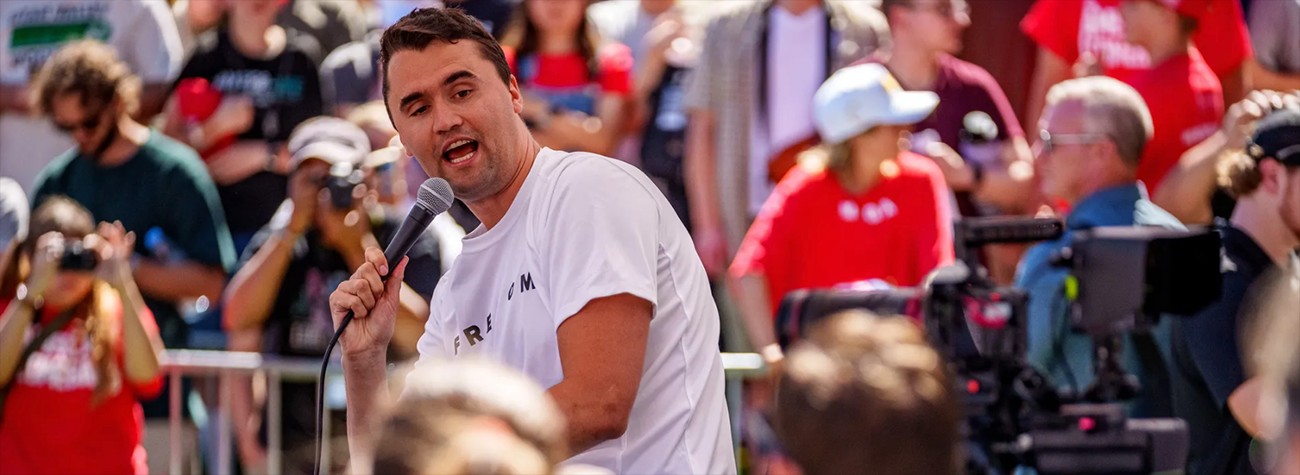

This is an article in defence of free thought and Christian values.
I greatly admired Charlie Kirk. Today, in some US states, is the Day of Remembrance dedicated to him. In any case, today would have been his thirty-third birthday.
I liked Charlie Kirk when he was alive, very much enjoyed following him and naturally warmed to him. Perhaps I know no one in Italy who followed him. I spoke about him only with the English friend who first drew my attention to him. Mostly, I listened to him and read his work on my own.
Then he was killed, labelled an extremist and became famous outside the United States too. As often happens, I heard him discussed by people who did not know him, had never listened to him and had never read anything he had written. People who spoke about him on the basis of hearsay, newspaper headlines and partisan allegiance.
I do not presume to explain him to those who did not know him, or those who never wanted to look more closely or understand him. I only want to say that I was deeply saddened by his killing, that I think dialogue is a wonderful means of engaging with others, and that he had the courage, strength and intelligence to take dialogue into the very home of those who thought differently from him. I mean American university campuses, which, probably even more than those in Italy, bring together the intellectual elite that, whether in posture or in substance, is at the forefront of embracing social change.
In Charlie Kirk, I saw a Christian convinced that America and the West had much to defend and much to be proud of. Freedom, responsibility, and individual and fundamental rights: family, faith, civilisation and values. His priorities were clear: defending the family founded on marriage between a man and a woman, opposing abortion, scepticism about the necessity of gender transitions, criticism of diversity, equity and inclusion policies understood as a substitute for merit, and combating irregular immigration.
I simply cannot regard it as extremism to consider the family an institution to be protected, to demand respect for borders, to defend prenatal life or to insist on selection based on competence. These are political and moral positions that a free society can discuss calmly too.
The labels of extremist or fascist attached to him, especially post mortem, become shortcuts that make it possible to avoid any discussion and to try to discredit an entire political outlook that is legitimate and widely shared (in the US, judging by the elections, it commands more or less equal support).
Kirk’s Republican allegiance also becomes obvious when we start from his priorities. For a Christian conservative who attaches decisive importance to prenatal life, the family and national sovereignty, the Republican Party is the only consistent choice between America’s two main alternatives. There is no need to attribute a monopoly on human dignity to one party to recognise this distance between them.
And let me be clear: to me, the Democrats and the Republicans are both democratic and legitimate parties. How much one likes the sitting President or the defeated challenger counts for nothing. What matters is their election manifestos, who receives funding, and how those manifestos are put into practice.
The 2024 Democratic platform supported pathways to citizenship for various categories of immigrants without regular status, and for those who regard regularisation as an incentive to further irregular immigration, the disagreement remains substantial.
On abortion, the Democrats proposed restoring federal protection and repealing the Hyde Amendment, which limits federal funding for abortions, with exceptions for rape, incest and danger to the woman’s life. Planned Parenthood reported $792.2 million in public reimbursements and grants in its 2023–2024 report.
But the political conflict over funding that organisation and expanding access to abortion was real. For Kirk, it concerned the value of life. And many Christians, in America and around the world, think as he did.
From Italy, moreover, we tend to judge America by how much we like its president. One may dislike Trump. But a predecessor’s measured, elegant style does not automatically make his decisions better. Between deportations and turnbacks, Obama kept or sent 5 million people out of America. Three and a half times as many as Trump. In the 2024 fiscal year, under Biden, ICE carried out 271,484 removals. That alone is enough to disprove the idea that deportation is a Republican prerogative.
Guantánamo, despite Obama’s pledge to close it, remained open even at the end of Biden’s presidency. It is a failure to be assessed alongside the obstacles Congress put in the way, not made to disappear behind a president’s progressive reputation. Now, under Trump, it is still open and holds only 15 detainees. As though Trump did not want to close it formally, but to make it disappear. So that it comes to an end rather than being closed.
With Iran, Obama opted in 2015 for an agreement that exchanged limits and inspections on the nuclear programme for sanctions relief. Its stated aim was to prevent the bomb; conservative criticism also concerned the economic benefit gained by a repressive regime. One can consider that compromise mistaken without describing diplomacy as allegiance to the ayatollahs, but what is certain is that they benefited from time and resources to pursue their atomic programme almost undisturbed. Yet one can also challenge it without being dismissed as an enemy of peace, especially when one considers how much information we lack to understand why one decision was taken rather than another.
It is in the context of these choices that I understand Charlie Kirk. His Republican allegiance expressed Christian values that I very largely share.
For all that, I neither feel able nor have any interest in endorsing his every sentence, every decision Trump makes or every action of the Republican Party. Mine is a broad view that very often holds up in the details too.
I admired him because he made convictions I share visible and brought them into public discourse.
I do not ask those who detested him for a posthumous conversion. I ask them to examine whether they judged the man, his words in full and his reasons, or merely the persona constructed to make him instantly detestable, or the isolated sentence taken out of context.
I am a Catholic Christian, anti-totalitarian, anti-fascist, anti-communist and anti-Nazi.
When I think of Charlie Kirk, I think he was one of us, or that I was one of his: defending the family founded on marriage between a man and a woman because I think it has meaning and a useful function in society too; opposing abortion because I believe in life from conception and already love, in the foetus, the man or woman they will become; profound scepticism towards gender transitions; total opposition to surrogacy; criticism of DEI policies when they leave doubts about merit and competence; security, legality, combating irregular immigration and unassimilated anti-Western ethnic enclaves because they are dangerous to society and to individuals.
On these points, I am willing to engage with anyone, and I assert the legitimacy of these positions. Open, like Kirk, to challenge and dissent. I do not expect unanimity on my positions, or unanimous agreement on Charlie Kirk’s identical ones, but I think they pose no danger to any democracy, that they can be expressed, that they deserve a place in an election manifesto and that they deserve to be judged at the ballot box.
I believe, rather, that what is extremist, fascist and anti-democratic is the position that demands that certain arguments cannot be voiced, the position that denies, discredits and kills dissent.