


We make a curious demand of the Earth: we would like it to stay as we found it. The coastlines where they are, the glaciers more or less unchanged, the Sahara a desert, the Po Valley fertile, temperatures within a range we recognise, rain in the seasons we are used to. We have built cities, roads, ports, houses, fields and tourist facilities within a particular climate and in particular places, and now we tend to regard that situation as normal.
But the Earth’s normal state is not stability. It is change.
The Earth is about 4.5 billion years old. Homo sapiens has existed for about 300,000 years. If the Earth’s entire history lasted twenty-four hours, we would appear in the final seconds. Yet it is precisely in those final seconds that we have begun discussing what the planet’s proper temperature ought to be.
This does not mean we do not matter. We are a tiny presence in the Earth’s history, yet we have become powerful enough to alter its climate a little: not enough to trouble the Earth, but enough to trouble ourselves. We are eight billion human beings who generally live for less than a century, but in that brief time extract coal, oil and gas, build cities, produce steel and cement, drive cars, take flights, heat and cool buildings, and grow crops and transport goods around the world.
The current warming is partly due to human activities. Human-produced greenhouse gases have played an important role in the recent rise in temperature. Most people know this. But what I want to stress is that even without us, or if we had done something else, the Earth would not have stayed the same. It simply cannot remain the same as itself.
It would not necessarily have experienced this warming, at this moment and at this speed. But it would have continued to change. Sooner or later, temperatures, rainfall, ocean currents, ice, coastlines and ecosystems would have changed. Over still longer timescales, it would have become apparent that the continents and their positions change too.
Because the Earth has always been changing.
When the first dinosaurs appeared, about 230 million years ago, almost all the land was joined together in Pangaea. Then that great continent broke apart. The Atlantic opened up. The continents continued to move, and still do today, by a few centimetres each year. It is so slow that we do not notice it during our lifetimes, but over millions of years it completely changes the planet’s geography. The opposite shores of the Atlantic move two and a half centimetres further apart each year, every year, regardless of what humans do.
The climate, too, has always changed. The Earth’s orbit changes, the tilt of its axis changes slightly, the distribution of solar energy changes. Ocean currents, volcanic activity, the amount of ice and the composition of the atmosphere change. What happens above the Earth’s crust changes, and so does what happens below it. Even the Sun changes over time. Let alone everything else.
Even the Earth’s magnetic field changes, and the magnetic poles shift. It is not a major driver of climate, but it is another example of how wrong it is to think of the Earth as a motionless machine. The point is simple: everything changes.
Our difficulty stems from the fact that we live too briefly to notice. Eighty years is a lifetime to us. Ten thousand years seems an eternity we cannot even conceive of. Whereas to the Earth it is almost nothing.
This is why we tend to take what we see during our brief existence and call it normal. Our coastline becomes “the coastline”. Our climate becomes “the climate”. The amount of rain we are used to becomes “normal rainfall”.
When something changes, we think the system has lost its equilibrium, but at most it has lost ours.
The Sahara is a good example. A few thousand years ago, vast areas of what is now desert were much greener, with lakes, vegetation and large animals. Giraffes and hippopotamuses lived in territories we now immediately associate with sand.
The giraffe, however, did not insist that the Sahara remain as it had found it. If the environment changed, animals moved, adapted, dwindled or disappeared.
We have a different problem. We have built cities, borders, ports, houses, fields, infrastructure and economic systems. We decided where a road must run and where the sea ought to stay. Then we discovered that the Earth had signed no contract with us.
This is where one of the most widespread confusions in the climate debate arises. A relatively stable climate is immensely valuable to us. But “valuable to us” and “natural” are not the same thing. A stable coastline suits us. A certain amount of rain suits us. A temperature suited to the crops we know suits us. A stable sea level suits us very well indeed. But this does not mean the Earth has a duty to preserve them, or that doing so is in its interests.
When we say we must “save the planet”, then, we are using a very anthropocentric expression. The planet does not need saving. It existed for billions of years without us and can carry on perfectly well without us. The Planet does not care about humans, even if they put their printer cartridges in the food waste bin. It takes a few hundred million years and perhaps turns them into coloured diamonds.
What we want to save is ourselves, our cities, our economies, our infrastructure and the world we have built. That is reasonable, but it is a different matter.
The Earth has already experienced temperatures very different from today’s. It has had much lower and much higher seas. It has had far more extensive ice. It has had much warmer periods. It has had completely different continents.
And that is precisely why we should be less anthropocentric. We keep talking as though the problem were the planet’s health, when the real problem is the compatibility between the planet’s changes and the way we have organised our brief lives over the short term.
Let us get used to the idea, then, that if it is not us, it will be our children who move. Some cities will be abandoned, some coastlines will change, some species will disappear and others will appear. There will be new migration flows. Our grandchildren may live far from the places where we grew up, and their children further still.
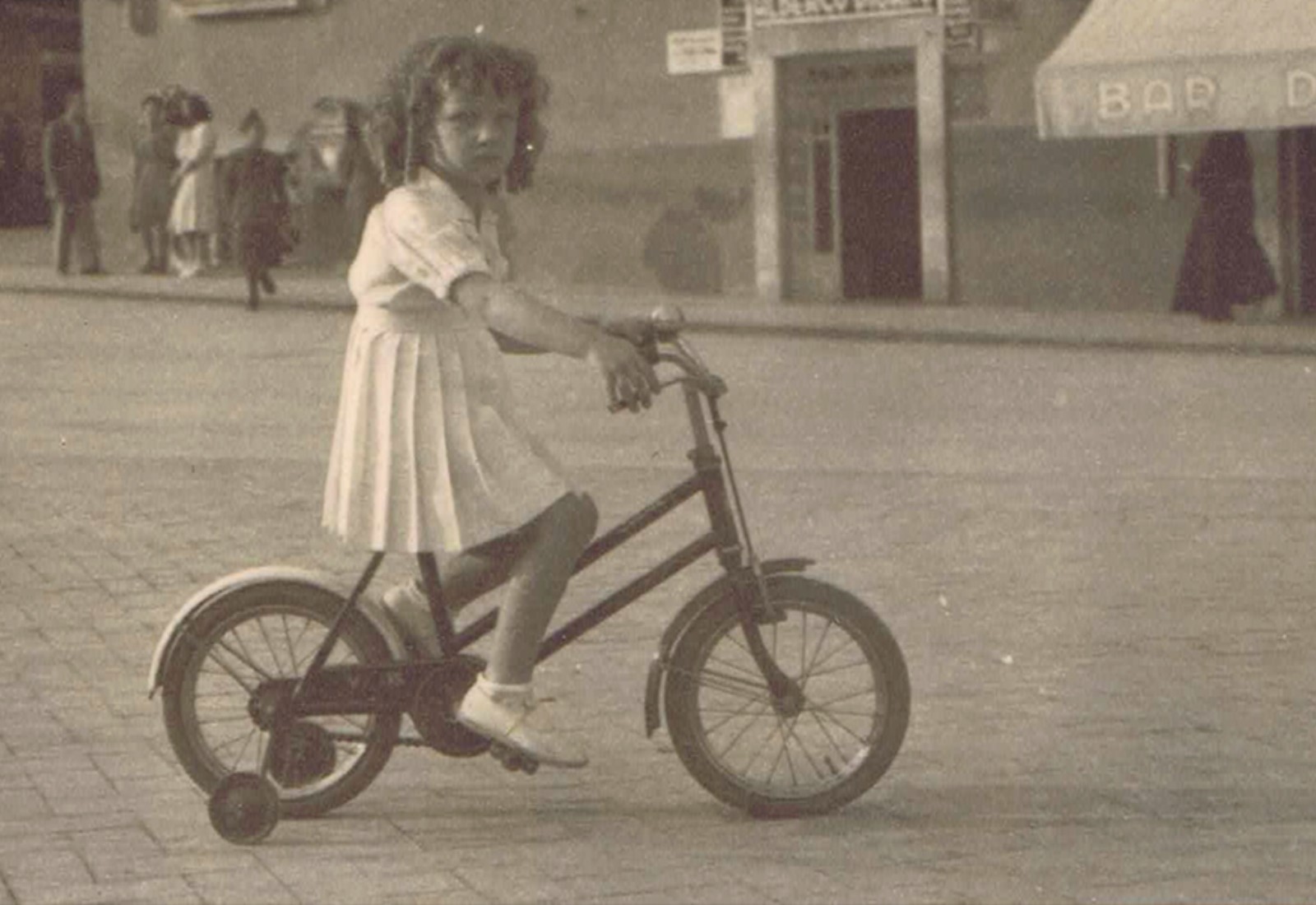
This seems enormous to us because we look at the future from our own position and would like to preserve it. But we know almost nothing about our great-great-grandparents. We do not know where they lived, what they saw from their windows, which road they took to work or which landscape they considered home. In a few generations, exactly the same will happen to us. Like the little girl in the photograph, proud of her bicycle: who knows who she is, whether anyone still remembers her name, how many times she moved in her life?
This is why the idea of saving the status quo becomes, at a certain point, difficult even to understand. Saving it for whom? For people who will be born in a hundred and fifty years and who will probably feel no nostalgia for the world of 2026 because they will never have seen it?
Change, moreover, will not arrive one morning at eight o’clock. It will happen day after day, slowly enough to become everyday life. Cities have always been founded, grown, declined and been abandoned. There are mining towns built around resources that are no longer needed, settlements emptied because economies have changed, cities founded along coastlines that have since shifted, and entire communities relocated because the land on which they had sprung up no longer offered what it once did.
In a hundred and fifty years, part of Italy could be very different from the country we know. So could vast areas of Africa, Asia or America. Or other balances will have shifted in ways we cannot even foresee today. People will move, build elsewhere, abandon something and grow attached to something else. They will call what they find normal. Exactly as we have done.
The Earth, meanwhile, will keep changing. With us, despite us and after us. Let us make our peace with that.